



No blog posts match your filters.
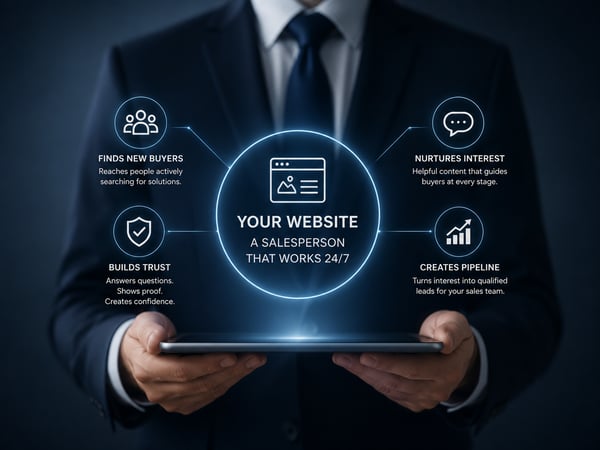
Your B2B Website Is a Salesperson. Is It Pulling Its Weight?
Some companies look great from the outside but hide a real problem. Sales are up. The pipeline is full. The team wins deals. But look at where each customer came from. It is almost always a referral, a cold call, or a relationship. The website had nothing to do with it. This is very common for mid-market B2B companies. It is also risky. Referrals and cold calls still work. But they have a ceiling. They only grow when you add people. They lean on a few key players. And they leave one channel doing nothing, the one that could sell even while your sales team sleeps. Your website is already a salesperson. The question is whether it is doing any selling. The Referral Trap Referrals feel great. And they are a good sign. But they prove that people liked your past work. They do not prove you can create new demand on your own. Here is the trap. Referral-based growth feels healthy, right up until it isn't. The pipeline looks full. Win rates are high. Then a top rep quits. A big account leaves. The market slows down. And you have no backup plan to bring in new deals. The best companies treat their website as a way to create demand. Not a brochure. Not a badge for buyers who already trust you. A real tool that finds new buyers, teaches them, and turns them into leads. This matters more in 2026 than ever. Your buyers do their own research first. Even the ones who come from a referral. They type questions into Google. They ask ChatGPT and Perplexity to compare their options. They form opinions about you before they ever talk to a person. If your website is not part of that research, you are not on their list. What Most B2B Websites Actually Do Look at ten mid-market B2B websites in any field. You will see the same setup almost every time. A homepage with a slogan no one outside the company gets. A Services page that lists what they do but not why it helps the buyer. An About page that says “our people are our greatest asset.” And a Contact form that might as well say “reach out when you are ready to buy.” These sites are built for the company, not the buyer. Each part answers a question the company wants to answer. Almost none of it answers what the buyer is really asking. Things like: Do they get my problem? Have they fixed it for someone like me? What will it cost? What happens after I reach out? So the website becomes a checkpoint. Buyers visit it after they already chose to talk to you, just to make sure you are real. It does not create new deals. That wastes an asset you already pay for. How Search and AI Work Together Now Six years ago, visibility was simple. Rank on page one of Google for what your buyers search, and traffic follows. That is still true. But it is no longer the whole story. AI search has changed how buyers look for vendors. Think Google's AI Overviews, ChatGPT, Perplexity, and Gemini. Instead of clicking ten links and sorting it out, buyers now ask one question and get one answer. And the sources behind that answer are not random. They come from the same kinds of sites Google has always liked. Sites with clear know-how, well-organized content, steady publishing, and strong signs of trust. So the path to AI visibility runs right through good old SEO. The common thread is trust. Google uses a test called E-E-A-T. It stands for Experience, Expertise, Authority, and Trust. That same test decides whether your content shows up in an AI answer. Write clear, useful, specific content that proves you know your work, and you show up in both places at once. For B2B companies, this is a big chance. Most of your rivals' sites do not clear this bar. They have the same brochure problem you do. The company that starts building real, helpful content pulls ahead. And that lead grows over time. Referrals and cold calls cannot match it. Humans Close Deals. Websites Fill the Funnel. Here is what AI has made clear. Big B2B deals are still human. No one picks an IT provider, a marketing agency, or a services firm through a chatbot. The trust, and the read on whether you are a good fit, happen between people. But what comes before that talk has changed. Buyers know more, dig more on their own, and doubt more than they did six years ago. By the time a buyer agrees to a call, they may have read three of your blog posts. They may have watched a rival's case study. They may have asked an AI to compare you to two others. That first call is no longer the intro. It is the test. This raises the bar for your website. Being believable is not enough. It has to be convincing. It has to move a careful, well-read buyer from “just looking” to real interest. Then it has to hand that buyer to your sales team at the right time with the right background. That is not a brochure. That is a sales system. What a Lead-Generating Website Needs A clear answer to the buyer's first question A first-time visitor has one question. “Is this company for me?” Your site should answer that in seconds. Say who you help, what problem you solve, and why you are the right pick. A vague line like “We help businesses grow” says nothing. A clear line like “We build revenue systems for mid-market B2B companies that have outgrown their CRM” says a lot. It makes them want to keep reading. Content that builds trust before the call The best thing your site can do is prove your skill before anyone asks. A set of truly useful content does three jobs at once. Think guides, simple frameworks, and honest points of view from people who have done the work. It builds trust with buyers. It shows Google and AI that you know your field. And it gives your sales team things to share during the sale. This is not about pumping out lots of posts. It is about proof that you can be trusted. Ways to reach out that match the buyer Not every visitor is ready to ask for a proposal. A site with only one button, “Contact Us,” only catches buyers who already decided. Good B2B sites offer a few options. A big-step option for ready buyers, like book a call or get an assessment. A mid-step option for people still checking, like download a guide or join a webinar. And a small-step option for early researchers, like subscribe or read more. The goal is to catch buyers at every stage, not just the ones at the finish line. Tracking tied to sales, not vanity numbers The old numbers were page views, bounce rate, and time on site. Those are just stand-ins. What you really want to know is simple. Which content brings in good visitors? Which paths lead to sales talks? And what is a website lead worth next to a referral or a cold call? Tools like GA4 and HubSpot can answer this when set up right. The shift is from tracking activity to tracking real pipeline. Hold your website to the same bar you hold your sales team. A solid technical base for search and AI Visibility is not just about content. It is also technical. Schema markup, for articles, FAQs, and authors, helps Google and AI see what your content is, who wrote it, and why to trust it. Fast load times, good mobile performance, and a clean site setup decide whether your content even gets found. This work is not flashy. But it holds up everything else. The Math That Makes the Case CEOs who doubt marketing spend often ask the same thing. “What is this really worth?” It is a fair question. Here is a way to answer it before you spend a dollar. Start with the value of one customer. Take their yearly spend and multiply it by how long they stay. Next, find your close rate on good leads. Then figure out how many good leads your website would need each month to pay for itself. At normal B2B close rates and deal sizes, just one extra good lead a month often covers the whole program. That is true even for a site that used to bring in zero. Here is the better way to think about it. Your website is not a cost with a fixed budget. It is a channel with a clear cost per lead. And you can improve that cost over time. A sales rep can get hired away. A referral network stops growing once you have used up your contacts. Your website does neither. It builds on itself. Where To Start Most companies do not need a full rebuild to start getting leads from their site. They need to make a few clear choices. Who is the site for? What should it say? How should it turn visitors into leads? And how will you measure it? Companies that do this well share one trait. They stop treating the website like an IT project or a design task. They treat it like a revenue tool. Every choice, what to write, what to offer, what to track, runs through that lens. Your sales team already works hard. The question is whether your website works at all. Frequently Asked Questions How long before a B2B website starts bringing in leads? Paid search can bring in good traffic within days. Organic search and AI visibility take longer. Plan on three to six months before your content pulls steady traffic. But those gains build over time in a way paid ads do not. Most companies run both at once. Paid for quick wins, organic for long-term value. Do I need a lot of content to rank in search and AI results? Quality beats volume. A tight set of twenty well-researched, truly useful posts on what your buyers search will beat a hundred thin ones. The goal is to be the most useful, most trusted source on the few topics your best customers care about. You do not need to cover everything. Is SEO still worth it now that AI is changing search? Yes. AI search pulls from the same trust signals as regular search. The content, authority, and trust that help you rank in Google are the same things that get you cited by AI Overviews, ChatGPT, and Perplexity. SEO and AI visibility are not two different bets. They are one bet seen from two sides.

Should You Still Invest in Google Ads as AI Changes Search?
It's a fair question. People are using ChatGPT or another LLM to research products. Google is answering more questions directly in search results. AI Overviews can summarize an answer without the person ever clicking a website. So, do businesses still need to invest in Google Ads? Yes. AI is absorbing the early research stage of the buyer journey, not the moment someone decides to act. Google Ads still capture that moment, the search that happens once a person already knows roughly what they want and is comparing specific options. That distinction, between researching and buying, is the whole answer. The rest is the “why” and the “how.” Researching Intent vs. Buying Intent: The Distinction That Matters Now Think about how you use search compared to a few years ago. I used to Google almost everything. Now, if I'm trying to understand a complicated topic, compare a few ideas, or figure out what I should even be asking, I'm probably starting with ChatGPT or Claude. I'm not alone. Some of the searches businesses used to rely on for traffic are shifting there too. Someone looking for a basic definition may never click through to a website. AI can answer that on its own. But researching and buying aren't the same thing. At some point, the person researching a problem has to find the company, product, or service they're actually going to use. Researching Intent The searcher is still learning, comparing categories, or figuring out what to even ask. Example: “what is account-based marketing.” Buying Intent The searcher already knows what they want and is comparing specific providers. Example: “ABM agency” or “best ABM agencies for SaaS.” Intent Type Example Search Where AI Shows Up Where Google Ads Shows Up Researching “what is account based marketing” Often fully answered by AI, no click needed Rarely converts, low commercial value Buying “best ABM agencies for SaaS” AI may shortlist options High-intent moment, Google Ads’ strongest zone AI can easily answer the first kind of search. It can't replace the second kind, because at that point the person is choosing between real options, and that's exactly where Google Ads have always been strongest. Google Ads Capture Demand. They Don't Create It. This is something I think gets lost in paid search conversations. Google Search Ads are really good at capturing existing demand. Someone has a problem. They know enough about that problem to search for a solution. Your ad shows up at that exact moment. But if nobody is searching for what you sell, adding more keywords and increasing the budget isn't going to magically create demand. I've seen businesses try to force Google Ads to work for products or services people don't know exist yet. The campaigns struggle, and eventually the conclusion is that “Google Ads don't work.” Sometimes that's not the problem. Sometimes the business is trying to capture demand that doesn't exist yet. That's where other channels matter. Paid social, video, content, events, and PR can introduce the problem or solution before someone ever opens Google. The job of Google Ads is to be there once that awareness turns into intent. Branded Search May Matter More, Not Less This is the part I keep coming back to. More research is moving into ChatGPT, AI Overviews, Gemini, etc. People may do less of their early research on traditional search engines. But what happens after the research? In my experience, this is often where branded search comes in. A buyer used to search ten different questions and visit ten different websites. Now they might ask an AI tool to help narrow down their options, then go to Google and search the names of the two or three companies they want to look at further. That makes a deliberate branded search strategy more important, not less, as AI reshapes how people research. Someone might already know your brand from Claude, a podcast, LinkedIn, or a recommendation. Their Google search isn't necessarily the start of their journey. It might be one of the last steps. I push back on one common claim: “We rank number one organically for our brand, so we don't need to run branded ads.” Maybe. But I want to look at the actual search results first. Are competitors bidding on your name? Are third-party review sites showing up? Is a large AI Overview, shopping block, or local pack pushing your organic listing down the page? The search results page isn't ten blue links anymore, and owning more of it can matter, especially when the person searching already knows who you are. SEO, GEO, and Paid Search Aren't Separate Islands Marketing teams love putting channels into boxes. SEO owns organic search. Paid media owns Google Ads. Someone else is suddenly responsible for GEO. What GEO Actually Means GEO, or generative engine optimization, is about making it easy for AI systems like ChatGPT, Gemini, and AI Overviews to understand and surface your brand in generated answers. That's not how people actually research, though. A buyer might discover a company in ChatGPT. Then they see the brand again on LinkedIn. They Google the company name, click a paid ad, and leave. Three days later they come back through an organic search. They finally convert through direct traffic. Which channel gets credit? Wrong question. The better question is whether the company was visible throughout the process. Google Ads don't directly make a company more likely to get cited by an LLM (ChatGPT, Claude, Gemini, etc) or show up in an AI-generated answer. But paid search still supports the bigger visibility picture. It helps capture demand created elsewhere. It gives you faster feedback on the words buyers actually use. And it shows you which problems and solutions drive action, not just traffic. That information should get shared across paid search, SEO, content, and GEO. The channels are different. The person researching doesn't care. When Google Ads Aren't the Answer I love Google Ads. I also don't think every business should run them. If there's little to no search volume for your product or service, search ads may not be the best place to start. Say your sales cycle is long, and your conversion tracking stops at a form fill. You might end up optimizing for leads that never become customers. If your landing page doesn't clearly explain what you do, more traffic won't fix that. And if you can't connect marketing activity to actual business outcomes, spending more won't help. You'll just spend more without knowing what's working. Google Ads work best when there's existing intent to capture and the infrastructure to measure what happens after the click. Without those two things, the answer isn't always “spend more.” Sometimes the answer is to fix the foundation first. So, Should You Still Invest in Google Ads? Yes, but be more deliberate about why. Google doesn't own the entire research journey anymore. The value of Google Ads is that search still captures moments of intent. AI may help someone understand their problem and build a shortlist. But when that person searches for a solution, compares providers, or types a brand name into Google, there's a reason behind it, and that's the moment Google Ads can still be incredibly valuable. If you're not sure where your brand actually shows up right now, across paid, organic, and AI-generated answers, that's worth a real look before you touch the budget. See Where Your Brand Shows Up in Search Get a free look at your brand's visibility across paid search, organic results, and AI answers like ChatGPT and Google's AI Overviews, before you decide where to shift budget. Frequently Asked Questions Is Google Ads still worth it if people are using AI to research? Yes, for the buying stage. ChatGPT and AI Overviews are absorbing early, informational research queries, but Google Ads capture the later moment when someone already knows what they want and is comparing specific options, which is where paid search has always performed best.. What is GEO in marketing? GEO stands for generative engine optimization. It's the practice of structuring content so AI systems like ChatGPT, Gemini, and Google's AI Overviews can understand it and surface it in generated answers, similar in spirit to SEO but built around how AI systems extract and cite information rather than how they rank pages. What is the difference between AEO and SEO? SEO, or search engine optimization, focuses on ranking web pages in traditional search results like Google's blue links. AEO, or answer engine optimization, focuses on getting content selected as the direct answer in featured snippets, voice search, and AI-generated responses. SEO is about visibility on a results page, while AEO is about being the answer itself, and both rely on similarly clear, well-structured, and specific content. Should branded search campaigns be cut if a company already ranks first organically? Not automatically. Ranking first organically doesn't account for competitor bidding on your brand name, review sites appearing above your listing, or AI Overviews and shopping blocks pushing your organic result further down the page. Check the actual search results page before dropping branded ad spend. Do Google Ads help a brand get cited by AI tools like ChatGPT? Not directly. Google Ads don't influence whether an AI system cites or surfaces a brand in a generated answer. What paid search does provide is faster data on the exact language buyers use and which offers drive action, information that can inform SEO and GEO efforts even though the channels themselves work independently. What's the difference between researching intent and buying intent in search? Researching intent is a searcher still learning about a topic or category, for example “what is account based marketing.” Buying intent is a searcher who already knows what they want and is comparing specific providers, for example “best ABM agencies for SaaS.” AI tools increasingly answer researching-intent queries directly, while buying-intent queries remain where Google Ads perform best.